Earning power Tag

blank

Professional profiles of art and design courses launched

At ArtEZ University of the Arts in Zwolle, the updated professional and education profiles for fine art and design are festively launched. It is an important milestone for both art education and the professional field. The previous edition appeared in 2013 and was in urgent need of updating.

The new profiles were developed by the OBK in collaboration with an expert working group and with intensive input from professionals, teachers and students from across the country. Through working sessions and broad consultation, a solid foundation was laid that reflects the diversity of contemporary art and design practice. The Visual Arts chain table also contributed to this effort.

Download professional profiles here and view more information here.

blank

Professional and education profile of fine art and design

Publication: 01/04/2025 Photo: fairPACCT

The visual arts sector is stable and finely tuned, but at the same time it is vulnerable and still not very well off. That is the conclusion of the agencies HTH Research (artists) and Berenschot (organizations) in the report “Collective Selfie #5. Figures and trends in the visual arts.’ They also conclude, together with the client Beeldende Kunst Nederland, that more research is needed for a solid knowledge base.

Image, data and fair pay

The research report was presented to Jan Jaap Knol, director-director of the Boekman Foundation, on March 28 during Art Rotterdam. This national knowledge center provides, among other things, the Culture Monitor and stimulates research by universities and others. In his opinion, the visual arts provide the “image” desired in society. But good “data,” as systematically recorded in the five successive Collective Selfies, are also increasingly necessary for policy and activities. Furthermore, given the apparent limited incomes of visual artists everywhere, fair pay should be a concern.

Visual artists

There were around 15,000-16,000 visual artists from 2015 to 2023, slightly more women than men. Sixty percent live in the western or central part of the country. Almost everyone has a personal gross income of up to €30,000 per year. One in three lives in a household with that same income. The figures are related in part to the “Monitor Artists and Other Workers in Creative Occupations, 2025 Edition. d.d. March 31, produced by CBS at the request of the Ministry of OCW. This shows, among other things, that artists are less likely than other working people to be satisfied with their income. For a small portion of visual artists, there are various types of grants with the Mondrian Fund. Municipalities can support through maker funds, studios, incubators c.s.

Institutions, postgraduate and for contemporary visual arts

Four post-academic institutions are subsidized by the state, where a selected group of artists can further develop artistic practice. The total turnover of 91 contemporary visual arts institutions in 2022 was €65 million. It employed nearly 700 FTEs, more than 150 of whom were interns or volunteers. There are currently 97 organizations affiliated with The Case Now. Six are subsidized as presentation institutions by OCW and 44 as art venues by the Mondrian Fund, together with nearly €15 million a year. A shared responsibility applies to the 36 municipalities with a decentralization allowance for visual arts.

Galleries, art fairs and festivals

The last survey by the Dutch Gallery Association (NGA) was in 2021; it will be repeated soon. The 445 galleries in 2020 had total sales of €92 million and represented over 7,800 Dutch and foreign artists. There are currently 451 galleries, nine of which are purely online. Ninety of them are affiliated with the NGA. There is a strong trend toward online sales and sales as a whole are rising. The Mondrian Fund’s Art Purchase Scheme, temporarily inactive, is proving to be a good incentive. Other direct government subsidies are lacking. There is no current survey data on the +15 art fairs and the approximately 100 visual arts festivals existing earlier in 2019.

Fine art museums

The Museum Association keeps the data current through the Museum Figures. One, together with the Mondrian Fund, counted 61 fine art museums in our country. There were a total of 6 million visits in 2023. Total sales are about €360 million. A census among 50 fine art museums showed 3,200 people employed, more than 2,000 FTEs. All governments give grants, but do not have policies specific to fine art museums.

The Mondriaan Fund and Platform ACCT contributed financially to the research “Collective Selfie #5.

Continue reading

Download the research report ‘Collective Selfie #5. Figures and trends in the visual arts.” presented March 28, 2025 hHERE.

Check out CBS’ Monitor Artists and Other Workers in Creative Occupations, 2025 Edition.” released March 31, 2025.

blank

‘Reference framework salaries and zzp rates chain table technicians’

Image: Martin Hieslmair

Digital culture makers and artists often have an interdisciplinary practice between art and technology, between performance and installation, and between researcher and technical producer. This makes this sub-sector complex and makes it difficult to get a handle on what are fair rewards for digital culture makers and artists. High time, then, to investigate what rates and working conditions apply within subsectors similar to digital culture. The Digital Culture Chain Table of Platform ACCT, for example, has had a frame of reference drawn up by research firm Social Finance Matters.

“To strengthen the income position of creators in digital culture and arrive at fair rates, it is helpful, if not necessary, to have references of what is ‘fair’ in other sectors that are similar or reminiscent in some respects of the work of creators in digital culture,” Social Finance Matters said. The reference framework provides an overview of working conditions and rates applicable for performing work and holding positions within the design, visual arts, engineering and research sub-sectors. Prior to and during the creation of the frame of reference, it was determined by the chain table participants and Social Finance Matters that these subsectors show the most affinity with digital culture.

Download the reference framework here

The frame of reference can be used as a guide by digital culture creators and artists when setting or negotiating rates. Clients within this sub-sector can also consult the frame of reference. In line with the frame of reference, the Digital Culture chain table will establish a zzp surcharge. Experience shows that digital culture makers and artists often incur additional structural costs for setting up and running their independent professional practice.

Curious about the progress of the chain table Digital Culture? On the website or through the newsletter of the program fairPACCT you can stay informed!

blank

Status of application of artists’ fees guideline

Photo: Wikimedia

In October 2023 the starting signal was given and on March 22, 2024 the new chain table Visual Arts was launched. The chain table is formed by members of (branch) organizations that have been affiliated with BKNL (Beeldende Kunst Nederland) for some time. All links in the visual arts chain are represented: professional art education, visual artists’ organizations, galleries, art fairs, presentation institutions and museums. The Mondriaan Fund is a listener to the chain table. BKNL continues to exist as an informal consultation for knowledge sharing and interest representation in particular.

Intended activities
The chain table Visual Arts is working on the (by)develop practice tools, under the Fair Practice Code for the visual arts. These include maintenance and further updating of the 2023 Artist Fee Directive and the National General Conditionn Art Commissions from 2015. The chain table further aims to contribute to the Collective Selfie with an image of the sector (4e edition 2019, recalibration in 2024). On continuation of the chain table by 2025 may also include: work contributions/professional expenses, (socially) safe working environment plus conditions for rent and use of studios and incubators.

First praking tool: updated Directive Artists’ fees with subsidy
The updated 2023 Artists’ Remuneration Guidelines, effective 2025, was made in accordance with the practice at the fairPACCT chain tables. Therefore, it has been adopted by the Fine Arts chain table as its first fair pay practice tool. It concerns fees for artists at non-sales-oriented exhibitions and related linked assignments. The Mondrian Fund has a grant scheme to assist in the costs of the existing and of the updated directive.

View the updated Artists’ Fees Guidelines here.

Learn more

FairPACCT chain table Visual Arts

(continue reading under the heading ‘current’ or ‘across the table’)

Digital Culture survey results

Outcomes research on professional practice of digital cultural artists and creators: A vast field without strict boundaries

Publication: 15/10/24 | Photo: Tom Mesic

The Digital Culture chain table collected information on the independent professional practice of digital culture artists and creators based in the Netherlands. The goal: to be able to form a full picture of how digital culture artists and creators organize their professional practice, to gain insight into the current working conditions within the digital culture sector and to identify suitable and desirable working conditions. The results of this research are now available in the survey report “Digital Culture: A Vast Field Without Strict Boundaries.

Survey design and purpose

In March 2024, the Digital Culture chain table collected information from digital cultural artists and creators based in the Netherlands about their independent professional practice through an anonymous survey. 29 questions were asked, 11 of which were mandatory, divided into 5 categories:

  1. Profile
  2. Type of activities
  3. Reward
  4. Bandwidth of income
  5. Opinion on fair practice

The survey was conducted in both Dutch and English because of the large proportion of international digital culture artists and creators based in the Netherlands. Therefore, the report will soon be made available in English as well. The survey was fully completed by 87 respondents.

Not only do the survey results provide insight into how digital cultural artists and creators organize their professional practice and the current working conditions within the digital culture sector, they also serve as input for the Fair Practice Guide. The Fair Practice Guide is a document prepared by the chain table, led by Marije Baalman, that digital cultural artists and creators will be able to use when composing or negotiating their fees.

View all the practice tools from the Digital Culture chain table under the ‘practice tools’ heading.

Key survey findings

The survey results show that the digital cultural artist and creator is a jack-of-all-trades who performs many activities and work, within different roles and phases of the work process. Many of these activities and work are unfunded or underfunded. Respondents indicated that especially the writing of (concept) proposals and fund applications, travel time, maintenance of the work and research are insufficiently funded by the client. For more than half of the respondents, however, research is one of the three most frequently performed activities within professional practice, next to “design” and “storytelling. Because of insufficient funding, many unpaid hours are invested in assignments and projects. Only one respondent indicated that they never invest unpaid hours.

Awareness of the digital culture maker’s many roles necessary

Although respondents feel a very high urgency for fair and better pay at all, enforcing and implementing fair pay is difficult. The aspects on which funds measure, tight client budgets and not being able to determine the hourly rate themselves are, among other things, obstacles on the road to fair pay. Fair pay for digital cultural artists and creators requires, among both clients and the professionals themselves, greater awareness of the many roles that digital cultural artists and creators take on, and the work and activities that are performed as an extension of these, within the various phases that make up the work process.

Fair Practice meeting for creative sector The Hague

Fair Practice meeting for The Hague’s cultural and creative sector on Oct. 24

Publication: 01/10/24 | Photo: Rob Oo

A future-proof cultural sector is badly needed. Are you working in or for the cultural and creative sector in The Hague and would you like to share and exchange what Fair Practice and Fair Pay means for your own organization? Or are you curious what it can mean for the future of the sector? Then come on October 24 to the Fair Practice meeting for the cultural and creative sector in The Hague and the municipal policy makers involved.

For creative sector The Hague

Anyone working in or for the cultural and creative sector in The Hague with special interest in the labor market issues therein. Think of makers, technicians, production workers, municipal policy makers, directors, business leaders, HR staff, members of boards of directors and supervisory boards. In short: everyone working in the cultural sector in The Hague who is interested in Fair Practice and Fair Pay.

Challenges creative sector Hague

During this meeting we will discuss together what the current situation is around Fair Practice and Fair Pay in the cultural sector in The Hague. We will discuss the challenges and tools offered to meet those challenges. There is an opportunity to share experiences and exchange with each other from both municipal and sectoral perspectives.

Not yet familiar with Fair Practice? Check out the code of conduct.

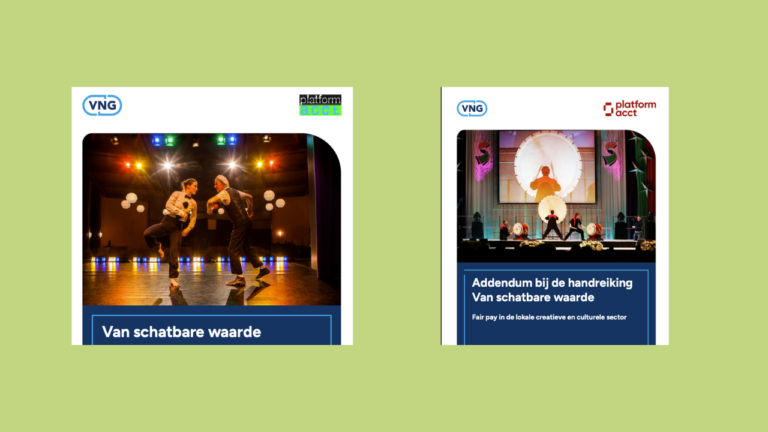
Especially for municipalities, Platform ACCT and the Association of Dutch Municipalities developed the handbook ‘Of estimable value’. Fair pay in the creative and cultural sector‘.

Speakers and program

Speakers: Jeroen Laven (Municipality of The Hague), Arjen Lakerveld (management consultation The Hague Performing Arts/Haags Cultuur Overleg (HCO)), Fenna van Hout (Association of Dutch Municipalities), Noud van de Rhee (Platform ACCT), Wouter Touw (CAOP)

Location: CAOP – Lange Voorhout 14, The Hague – room 157/158

Program:

3 p.m.

Welcome – Municipality of The Hague – Jeroen Laven


Introduction round

3:10 p.m.

Brief introduction – CAOP – Wouter Touw

3:15 p.m.

10 years of focus on the labor market in the cultural and creative sector – Where are we now? – Noud van de Rhee (Platform ACCT)

3:25 p.m.

Handbook ‘Of estimable value’ explained
Fenna van Hout (VNG)

3:45 p.m.

Short break

4 p.m.

Plenary discussion among attendees – experiences with and questions about Fair Practice in The Hague’s cultural and creative sector – led by Arjen Lakerveld (Directieoverleg Haagse Podiumkunsten/Haags Cultuur Overleg (HCO))

5 p.m.

Conclusion and possible follow-up actions

5:30 p.m.

Drink

Sign up

Register at secr-zorgcultuursport@caop.nl, quoting Fair Practice CCS The Hague. There is room for about 30 people, so sign up soon.

blank

What is Fair Practice and how can it advance your daily practice? Sign up for the International Clinic: Fair Practice on Sept. 19!

Publication: 13/09/24 | Photo: Salih Kilic

International Clinic 2024: Fair Practice

Location: New Institute

Date: Thursday, Sept. 19

Time: 3:30 p.m. – 6:30 p.m.

Language: English

Participation: free of charge

What is Fair Practice and how can it advance your daily practice? How can you help make the design and cultural field fairer? And how does Fair Practice work in an international context? These are some of the questions addressed during a conversation with people from cultural organizations and practitioners, followed by breakout sessions with fairPACCT.

Using the Fair Practice Code in the Netherlands, a moral compass for anyone working in or with the creative sector, we reflect on our cultural practice based on the code’s five values: solidarity, diversity, trust, sustainability and transparency.

Program

  • 15:30 PM | Conversation on Fair Practice with Marije Baalman (curator, activist and participant roundtable Digital Culture fairPACCT), Noud van de Rhee (program manager fairPACCT), Yassine Salihine (product designer), Elena Polivtseva (independent researcher, co-founder Culture Policy Toom) and Simon de Leeuw (program maker, secretary EUNIC NL & Global Focal Point), moderated by Servaz van Berkum.
  • 4:30 pm | Breakout sessions: Social Safety & Fair Pay/Fair Practice
  • 5:30 p.m. | Networking drinks
  • 6:30 p.m. | End of the program

Register here for free to participate in the International Clinic 2024: Fair Practice

This event coincides with the New Institute’s free Thursday Night Detour. Guests can visit the exhibitions for free between 5:00-21:00 pm and participate in a Thursday Night Detour at 7:00 pm.

International Clinics

The International Clinics provide a platform for Dutch-based designers to gain more insight into the opportunities, challenges and best practices of working internationally. The International Clinics are organized quarterly with partners DutchCulture, Creative Industries Fund NL and the Diplomatic Network. The Clinic offer creators an opportunity to share international knowledge, experiences and networks in order to build meaningful collaborations.

For more information, contact Marie-Anne Souloumiac.

blank

The value of professional photography highlighted

Design: Formfest

The chain table Photography of Platform ACCT/fairPACCT aims to improve the position of photographers in the labor market. The first question that arose was: what social and cultural value is attached to this sub-sector and the profession? This is made clear in the 1st practice tool from the chain table: ‘The value of professional photography’.


Report shows great and diverse value
Three authors worked with the chain table to address the question of value. Based on 12 interviews with six workers and six clients, the overall conclusion in their report is: the value of professional photography is considered high. Nine values were specifically mentioned and described. Such as window on the world, show the truth, be immediate, make recognizable, be accessible, convince, make visible, offer emotion, capture. Furthermore, the optics on the future with AI is: good photographers with a strong vision, own style and clear story will keep assignments.


Desire for two-year program
At the same time, it was recognized in the interviews that talking about photography and naming its underlying values is done too little. This applies to the photographer as well as the user and viewer. More help should be given to the profession to be more aware of the value they add and represent. There should therefore be a program, starting at two years, to grow (self)confidence in photography and begin to better utilize its social and cultural value. The program consists of three focal points: debate and meeting, education and communication.


Already the podcast ‘Everyone takes pictures’
One of the authors of the report on the value of photography, given the urgency, has started working on more communication right away. Anne Bloemendaal of Flowerdales Agency now has the podcast ‘Everyone takes pictures’ in which she explores the value of photography in more detail. She talks to photographers, clients and others about various current themes.

Read and listen further

blank

‘Reference framework rates digital culture’ provides insight into fair rates for digital culture creators and artists

Image: Martin Hieslmair

Digital culture makers and artists often have an interdisciplinary practice between art and technology, between performance and installation, and between researcher and technical producer. This makes this sub-sector complex and makes it difficult to get a handle on what are fair rewards for digital culture makers and artists. High time, then, to investigate what rates and working conditions apply within subsectors similar to digital culture. The Digital Culture Chain Table of Platform ACCT, for example, has had a frame of reference drawn up by research firm Social Finance Matters.

“To strengthen the income position of creators in digital culture and arrive at fair rates, it is helpful, if not necessary, to have references of what is ‘fair’ in other sectors that are similar or reminiscent in some respects of the work of creators in digital culture,” Social Finance Matters said. The reference framework provides an overview of working conditions and rates applicable for performing work and holding positions within the design, visual arts, engineering and research sub-sectors. Prior to and during the creation of the frame of reference, it was determined by the chain table participants and Social Finance Matters that these subsectors show the most affinity with digital culture.

Download the reference framework here

The frame of reference can be used as a guide by digital culture creators and artists when setting or negotiating rates. Clients within this sub-sector can also consult the frame of reference. In line with the frame of reference, the Digital Culture chain table will establish a zzp surcharge. Experience shows that digital culture makers and artists often incur additional structural costs for setting up and running their independent professional practice.

Curious about the progress of the chain table Digital Culture? On the website or through the newsletter of the program fairPACCT you can stay informed!

blank

Status of application of artists’ fees guideline

Photo: Wikimedia

In October 2023 the starting signal was given and on March 22, 2024 the new chain table Visual Arts was launched. The chain table is formed by members of (branch) organizations that have been affiliated with BKNL (Beeldende Kunst Nederland) for some time. All links in the visual arts chain are represented: professional art education, visual artists’ organizations, galleries, art fairs, presentation institutions and museums. The Mondriaan Fund is a listener to the chain table. BKNL continues to exist as an informal consultation for knowledge sharing and interest representation in particular.

Intended activities
The chain table Visual Arts is working on the (by)develop practice tools, under the Fair Practice Code for the visual arts. These include maintenance and further updating of the 2023 Artist Fee Directive and the National General Conditionn Art Commissions from 2015. The chain table further aims to contribute to the Collective Selfie with an image of the sector (4e edition 2019, recalibration in 2024). On continuation of the chain table by 2025 may also include: work contributions/professional expenses, (socially) safe working environment plus conditions for rent and use of studios and incubators.

First praking tool: updated Directive Artists’ fees with subsidy
The updated 2023 Artists’ Remuneration Guidelines, effective 2025, was made in accordance with the practice at the fairPACCT chain tables. Therefore, it has been adopted by the Fine Arts chain table as its first fair pay practice tool. It concerns fees for artists at non-sales-oriented exhibitions and related linked assignments. The Mondrian Fund has a grant scheme to assist in the costs of the existing and of the updated directive.

View the updated Artists’ Fees Guidelines here.

Learn more

FairPACCT chain table Visual Arts

(continue reading under the heading ‘current’ or ‘across the table’)